
Abstract
This research evaluated how much consumers approved of a new and healthy snack (Tilapia- Malunggay Kropeck). This study is very important because there is an increasing number of people wanting to purchase healthy low-cost convenient snacks made with ingredients that are available in their area. The study determined consumer approval of 3 types of (variations) of Tilapia- Malunggay Kropeck by measuring 4 criteria, appearance, aroma, taste, and texture. One aim of this study was to determine which sample was the most preferred through rank preference testing. The research used an experimental research design. 3 variations of Tilapia- Malunggay Kropeck were created and prepared in the same way. The preparation included washing/cleaning, removed fish bones, drying the leaves (step 1); combining all ingredients (together), steaming, cooling, cutting, drying (step 2), & frying. 50 respondents participated in the study, who were selected using a non-random method. The respondents used a 5-point Likert scale to rate each sample product. The weighted mean and rank preference testing method were used to analyze the data. For all sensory evaluations, Sample 3 had the highest appearance rating while Sample 2 and 3 had a moderate aroma rating. All three were rated as acceptable for taste, while Sample 1 and 3 were rated as acceptable for texture. Based on the results of the ranking method, Sample 1 had the highest ranking by respondents for the combination of all the sensory criteria measured. In conclusion, Tilapia - Malunggay Kropeck is an acceptable newly developed snack food that has commercial potential and future possibilities for further development. Research will face obstacles in terms of completing nutritional analysis, modifying the formulation and increasing the sensory evaluation of this food.
Keywords
Acceptability Consumer Kropeck Malunggay Tilapia.
Introduction
In developing food products, the needs of consumers are important. Consumers want products they can eat that will help keep them healthy and satisfied. A growing number of consumers want convenient, affordable, and nutritious food products. Food companies and researchers have conducted many studies and trials with local/regionally grown food products to produce food products that meet the needs of consumers while enhancing the nutritional value of those products as well as providing a healthier way of eating. According to the Food and Agricultural Organization, value-added foods are products that help improve food security, improve food sustainability, and promote the use of local resources. Gonzalez and Serrano (2021) concluded that more than ever before, consumers are aware of their health and seek to consume food products that are both healthy and have acceptable sensory properties (i.e., taste, odor, mouthfeel, appearance). For all ages, snacking has continued to be one of the most popular categories of food consumed by consumers, and thus, attributes that create ease of preparation for consumption make snack foods an attractive choice for many consumers.
As it pertains to available commercial snack foods, there appears to be little to no nutritional value among the vast majority of commercially produced snack foods; therefore, while they may be tasty, they likely will not provide any health benefits. Researchers have studied different food ingredients and combinations (e.g. fish, vegetables, and natural ingredients) to develop healthy alternatives to conventional snack foods. Based on the findings of Mendoza et al. (2020), snack food must have acceptable levels of all three sensory attributes (taste, nutrition, and appearance) for consumers to prefer them. Sensory attributes (appearance, aroma, taste, mouthfeel) are the primary purchasing drivers of these snack food products.In the Philippines, tilapia is among the most frequently eaten freshwater fish available to the Filipino population due to its very low price and good quality. According to the Bureau of Fisheries and Aquatic Resources (2023), tilapia consists of one of the most produced aquaculture foods in the country and plays a large role in the overall food supply of the country. Data provided from studies completed by El-Sayed (2020) support that tilapia contains a high source of protein, vitamins, and minerals, all of which promote health in people. Dela Cruz and Ramirez (2022) have also indicated that tilapia can provide raw ingredients to produce more nutritious processed products and to help support local aquaculture. Malunggay leaves are also well-known for being highly nutritious and contain numerous documented healing capabilities. As noted by Fahey (2005), malunggay is very rich in calcium, iron, potassium, vitamin A, vitamin C, and other antioxidant-like compounds, all of which contribute to enhancing human health. Leone, et al. (2018) have also documented that malunggay is such a highly nutritious food source that can significantly enhance the nutrition of food products if used as a protein component and/or added to a food product. Furthermore, Quitub, et al. (2016) stated that in addition to having high nutritional value, malunggay is such a widely used ingredient in food preparation within the Philippines because of being readily available and highly nutritious, so that adding malunggay to snack foods can enhance their nutritional value and stimulate product innovation. Kropeck is a popular snack item, known for its crisp texture and pleasing flavor. Kropeck is consumed by many consumers simply as an immediately ready-to-eat item, because of its low price and convenience. Currently, the majority of kropeck items sold commercially are produced based solely on flavor and texture, and consideration for enhancing food items nutritionally is rarely made. Therefore, the necessity to develop kropeck products using locally sourced ingredients is needed. The current research study was undertaken due to a growing interest in developing alternatives to traditional snack foods and to create a method of utilizing local food resources efficiently. The purpose of this research study is to determine consumer preferences for three different styles of tilapia - malunggay kropeck samples with regard to their appearance, aroma, flavor, texture, as well as to provide a comparative analysis of sensory evaluation data for each style from each of the three samples, so that the most preferred style can be identified. The results from this study should assist with food product development for future food product developers who desire to use tilapia and malunggay to develop healthy snack foods, and/or provide supporting documentation and insight to future researchers with regard to developing new and innovative food products.
Research Question
Specifically, this study aims to answer the following questions:
-
What is the level of consumer acceptability of the three samples of Tilapia-Malunggay Kropeck in terms of:a. appearance;b. aroma;c. taste; andd. texture?
-
Which among the three samples of Tamarind Leaves Chips is the most preferred based on the rank preference test?
Conceptual Framework
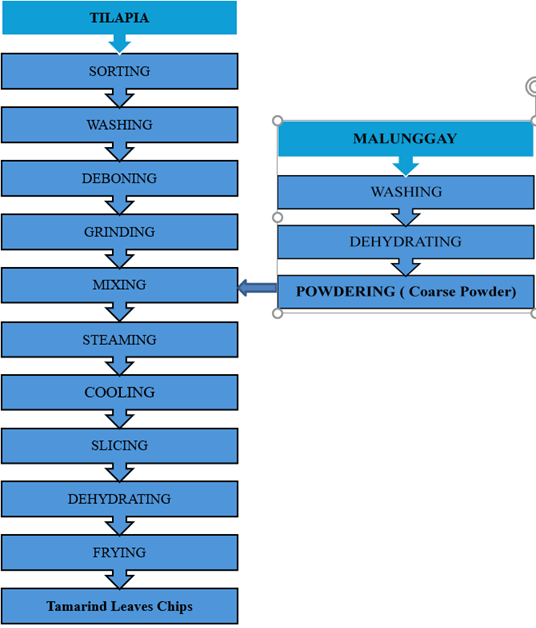
To carry out the research, first all raw materials required for the study were collected, followed by preparing, equipment, useable tools and utensils for making Tilapia-Malunggay Kropeck. Tilapia fish is made with the following main ingredients; Malunggay leaves, cassava starch, garlic powder, onion powder, salt, pepper and cooking oil. Since Tilapia is known for being an nutritionally dense source of protein, it was used as the meat addition to the kropeck, and Malunggay leaves were added to increase nutrition with their vitamins and minerals. Cassava starch was included for its ability to enhance texture and crispiness, and garlic powder, onion powder, salt and pepper were included to add flavor as well as aroma.
The preparation of Tilapia-Malunggay Kropeck began with sorting, cleaning and thoroughly washing the tilapia fish, which included deboning. The Malunggay leaves were then washed and dehydrated. After cleaning each item, the fish and dehydrated Malunggay leaves were combined using a food processor, then added to the dough-like mixture with cassava flour, garlic powder, onion powder, salt and pepper to form a raw mixture. The dough mixture was then placed in rolls in preparation for steaming; after steaming, the kropeck was cooked and firmed up. After cooling, the kropeck was cut into smaller pieces to be dried with a dehydrator to guarantee long shelf life. After complete dehydration, the kropeck was deep fried in hot oil until crispy and golden brown and cooled for sensory evaluation. The finished product was then analyzed for approximately 4 dimensions of acceptance, which included appearance, aroma, taste and texture, and the most accepted product would be batched for final selling.
Methodology
This study intends to determine the extent to which consumers will accept Tilapia-Malunggay Kropeck according to three separate samples created differently with different ratios and formulations of ingredients. The study was completed using a methodical approach that included gathering raw material, preparing equipment, processing, and formulating the product then creating three samples for evaluation, evaluating the sample using sensory methodology, and statistically evaluating the study results. Respondents provided evaluations based on how each sample regarding appearance, aroma, flavour, and texture would best represent their most favourable option of Tilapia-Malunggay Kropeck.
Gathering of Raw Materials
To ensure food safety and proper hygiene of the tools and utensils that are used in the preparation and processing of the Kropeck, including the knives, chopping boards, measuring cups, mixing bowls, frying equipment, baking equipment, trays, pans, steamers, dehydrators and other utensils, all of these items were cleaned and disinfected prior to the preparation of the Kropeck. The use of clean/sanitary tools and utensils are important to avoid contamination (cross contamination) as well as allow the quality of the product to remain constant through the entire processing of Kropeck. Proper sanitation of the tools and utensils also allowed for accuracy in measuring materials, the formulated product consistently to be processed the same across various ways of preparing Tilapia-Malunggay Kropeck, and the most effective use of time when performing the different steps used in preparing the Tilapia-Malunggay Kropeck for packaging.
Product Formulation and Preparation
The different formulations of Kropeck use varying combinations of Tilapia and Malunggay to produce the final recipe for Kropeck. Kropeck sample #1 had more Tilapia than sample #2 (which had equal amounts of Tilapia and Malunggay), while Kropeck sample #3 contained a higher proportion of Malunggay relative to Tilapia.
The following procedures were followed to prepare and process the above Kropeck samples:
(1) Preparation of Ingredients – To prepare Tilapia the fish was cleaned by removing bones using a knife, washing the Malunggay leaves, dehydrating them, and converting into coarse powder. All other ingredients (Cassava flour, garlic powder, onion powder, salt, and pepper) are measured accurately, as well as the amount of the other two ingredients to produce the Kropeck sample you wish to create.
(2) Mixing & Formulating – You will mix the prepared Deboned Fish Meat with Coarse Powdered Malunggay, as well as each of the remaining ingredients for Kropeck sample 1, until they are completely mixed into one homogeneous dough-like product.
(3) Shaping and Steaming Process – Once mixed, the Kropeck mixture will be shaped into rolls, and then steamed (at a specified temperature and period) to completely cook the product, improve its firmness, and develop a better overall texture.
(4) Slicing and Drying Process – After steaming, the Kropeck will be cooled (cooled or chilled) and sliced into thin slices of equal width and allowed to cool until all moisture is removed (dried) and they are crispy and have a longer shelf life.
(5) Frying, Cooling & Storing – The dried Kropeck samples will be deep-fried in preheated cooking oil until they are golden brown in color (crisp). Following the frying process, you will need to cool the Kropeck at the same temperature as the freshly cooked products to ensure maximum storage capacity in the containers that they will be kept in.
Research Instrument
The researchers used the sensory evaluation score sheet as their research instrument to assess the participants’ evaluation of the three Tilapia-Malunggay Kropeck samples in terms of appearance, aroma, texture and taste. Researchers used purposive sampling to select 50 people to serve as evaluators for the study.
Everyone who participated was asked to rate each of the three Tilapia-Malunggay Kropeck samples on an ordered five-point Likert scale (1 being not acceptable; 2 least acceptable; 3 moderately acceptable; 4 acceptable; and 5 highly acceptable).
The researchers used the combined results of all of the evaluators to assess the degree of overall acceptability of each of the three samples of Tilapia-Malunggay Kropeck.
Statistical Treatment of Data
The three samples of Tilapia-Malunggay Kropeck were analyzed statistically to identify the acceptability levels of the various sensory attributes, including appearance, aroma, taste, and texture. A weighted mean calculated the average value for each sensory attribute, the overall acceptability level of the sample, as well as which sample was most favoured.
1.Consumer’s Level of Acceptability
The sensory evaluation of consumer preference for food products includes testing the three (3) varieties of Tilapia-Malunggay Kropeck on their appearance, aroma, taste and texture characteristics. These four (4) sensory attributes (appearance, aroma, taste and texture) were used to measure the degree of consumer acceptability and preference for each of these three (3) varieties of Tilapia-Malunggay Kropeck at the conclusion of the research study. The results of the sensory evaluations provided researchers with the necessary data to determine which variety was most acceptable to consumers based on the acceptance ratio between all three (3) varieties of Tilapia-Malunggay Kropeck.
-
Appearance
| Sample | Mean Score | Description |
| Sample 1 | 2.44 | Least Acceptable |
| Sample 2 | 2.73 | Moderately Acceptable |
| Sample 3 | 4.36 | Acceptable |
Legend: 5 – Highly Acceptable 4.5 – 5.0 4 – Acceptable 3.5 – 4.49 3 – Moderately Acceptable 2.5 – 3.49 2 – Least Acceptable 1.5 – 2.49 1 – Not Acceptable 1.0 – 1.49
Table 1 presents a summary of consumer acceptability according to appearance for three different products sampled which are Tilapia-Malunggay Kropeck. In appearance, Sample 1 had a 2.44 Rating = Least Acceptable; Sample 2 had a 2.73 Rating = Moderately Acceptable; Sample 3 had a 4.36 Rating = Acceptable. Therefore, Sample 3 was appealing from an aesthetic standpoint compared to either of the two other samples. The product’s appearance has a significant impact on how a consumer is drawn to/sparks their interest in the product, and ultimately, how they will choose to purchase that product; namely, based on the colors, shapes, and visual styles of the food products.
| Sample | Mean Score | Description |
| Sample 1 | 2.45 | Least Acceptable |
| Sample 2 | 3.04 | Moderately Acceptable |
| Sample 3 | 3.13 | Moderately Acceptable |
Legend: 5 – Highly Acceptable 4.5 – 5.0 4 – Acceptable 3.5 – 4.49 3 – Moderately Acceptable 2.5 – 3.49 2 – Least Acceptable 1.5 – 2.49 1 – Not Acceptable 1.0 – 1.49
The amount of acceptance from different consumers for each of the three Tilapia-Malunggay Kropeck samples with respect to their aroma is outlined in the table below:1. Aroma
The average ranking of the aroma of each sample was rated based on consumer responses to three questions related to aroma. Sample #1 averaged a total rating score of 2.45 (least acceptable), Sample #2 averaged 3.05 (moderately acceptable), and Sample #3 averaged 3.13 (moderately acceptable). Therefore, an increased preference towards the aromas produced by samples #2 and #3 compared to sample #1 was due to the sensory experience provided through aroma and the consumer's perception of the food product being tested.
| Sample | Mean Score | Description |
| Sample 1 | 3.72 | Acceptable |
| Sample 2 | 3.69 | Acceptable |
| Sample 3 | 3.08 | Acceptable |
Legend: 5 – Highly Acceptable 4.5 – 5.0 4 – Acceptable 3.5 – 4.49 3 – Moderately Acceptable 2.5 – 3.49 2 – Least Acceptable 1.5 – 2.49 1 – Not Acceptable 1.0 – 1.49
The evaluation presented in table 3 describes the degree of acceptance by consumers of the taste profile of three samples. Sample 1 had an average score of 3.72, Sample 2 had a score of 3.69, and Sample 3 received a score of 3.08 for the purpose of acceptance based upon taste. Therefore, all participants rated the taste profile of all three Tilapia-Malunggay Kropeck samples as being acceptable. The importance of taste affects the degree of global consumer satisfaction with respect to food products and directly correlates with consumer food preferences.
| Sample | Mean Score | Description |
| Sample 1 | 3.84 | Acceptable |
| Sample 2 | 3.07 | Moderately Acceptable |
| Sample 3 | 3.58 | Acceptable |
Legend: 5 – Highly Acceptable 4.5 – 5.0 4 – Acceptable 3.5 – 4.49 3 – Moderately Acceptable 2.5 – 3.49 2 – Least Acceptable 1.5 – 2.49 1 – Not Acceptable 1.0 – 1.49
Table 4 show the analysis of three products based on their texture consumer rate. For sample one, producers received an average rate of 3.84 (acceptable), for sample two a 3.07 (moderate), and for sample three 3.58 (acceptable). Thus, based on these findings, consumers find that the texture of both sample one and three were better than that of sample two. Furthermore, texture is key to providing a good mouth feel when consuming snack food and as such will contribute to overall satisfaction with the snack food item consumed.
-
Most Preferred Sample of Tilapia- Malunggay Kropeck
-
ANOVA tests whether there are significant variations in perception of three varieties of Tilapia-Malunggay Kropek as they relate to the four characteristics of: appearance, aroma, flavor, and texture. The first objective of ANOVA is to see if there are statistically significant differences between means of the samples being compared. The second objective of ANOVA is to test the variance of the observed difference to determine if it was the result of random chance or a true difference among the groups of samples, based on the original purpose of the research/experiment.
| Sample | Total | Rank |
| 1 | 60 | 1st |
| 2 | 115 | 2nd |
| 3 | 125 | 3rd |
The results of a rank preference test conducted on three Tilapia-Malunggay Kropeck samples are displayed in Table 5. The rank for preference test results show that Sample 1 had the lowest total number of ratings by all raters (60) and was rated as the highest valued sample of the three samples; Sample 2 received a total of 115 ratings and was rated as the second highest valued sample of the three samples; while Sample 3 had the highest rated given by raters as 125, making it the lowest valued of the three samples.
The sensory characteristic rank preference tests asked raters to rank the three samples according to which sample they preferred based on the sensory characteristics of each sample. Based on the results of the sensory characteristic rank preference tests, it is clear that while Sample 3 has the most "acceptable" visual attributes, Sample 1 had the highest level of preference from raters, due to the balance of sensory attributes that it possesses.
Conclusions
According to the survey responses, the three varieties of Tilapia-Malunggay Kropeck provided acceptable levels of quality based on the appearance, aroma, taste and texture of each sample. Sample No. 3 provided the highest mean score for appearance and therefore, according to the survey results it is the best visually. Both Sample 2 and Sample 3 rated 2.5 for their aroma which indicates they were both rated as moderate to acceptable whereas Sample 1 was rated as unacceptable in this regard. All samples were accepted as having acceptable levels of taste were assessed by the respondents, however, and it was discovered that multiple combinations of malunggay and tilapia generated acceptable taste characteristics. The respondents rated the samples based on texture as Sample 1 and Sample 3 received rating scores that indicate they were acceptable while Sample 2 rated as moderate to acceptable.Based upon the rank preference testing, Sample 1 was rated the number one sample of "Tilapia-Malunggay Kropeck", followed by Sample 2 and last ranked was Sample 3. Although Sample 3 had the highest mean score for appearance, Samples 1 had the highest score for preference in relation to the balance of attributes measured, including aroma, taste, and texture. Therefore, the proportions of the ingredients in Sample No. 1 were adequate to yield the highest product acceptability.Consequently, this study has determined that "Tilapia-Malunggay Kropeck" can be produced as a desirable, marketable snack food product from several combinations of the ingredients without significantly affecting consumer acceptability. The overall acceptability ratings for palate quality measurements (taste and texture) indicate that all combinations of the ingredients received positive consumer responses. Finally, the findings of this study indicate that properly preparing the ingredients and achieving a balanced ratio between the ingredient types will help ensure that a product will have acceptable sensory characteristics and thus will be preferred by consumers.
Recommendations
The findings of this study suggest that there is a need for additional research to improve the formulation of Tilapia-Malunggay Kropeck by experimenting with various spices and flavoring agents, in order to enhance the sensory characteristics of the product (especially the smell and appearance). The results from the sensory evaluations showed that these two attributes rated the lowest among all of the categories. There is also a need to investigate additional ratios of Tilapia: Malunggay and their effects on consumer acceptance, texture, and flavor.
The authors recommend conducting further sensory evaluations using a larger and more diverse set of participants in order to support the commercial viability of these products. Additional research is necessary to evaluate the nutrient composition, shelf life, package quality, and stability of the Tilapia-Malunggay Kropeck, in order to improve the quality of these attributes and support them commercially.
The researchers also suggest producing Tilapia-Malunggay Kropeck as a new snack as a result of the higher acceptability sensory evaluation ratings. In addition, the product will serve as an alternative snack for local consumers; thus supporting food innovation and providing local producers with an increase in value.
References
- Bureau of Fisheries and Aquatic Resources. (2023). Philippine fisheries profile. DOI ↗ Google Scholar ↗
- Dela Cruz, J., & Ramirez, P. (2022). Utilization of tilapia in processed food products and its contribution to local aquaculture. Philippine Journal of Fisheries and Food Processing, 18(2), 45–56. DOI ↗ Google Scholar ↗
- El-Sayed, A. F. M. (2020). Tilapia culture. Academic Press. DOI ↗ Google Scholar ↗
- Fahey, J. W. (2005). Moringa oleifera: A review of the medical evidence for its nutritional, therapeutic, and prophylactic properties. Trees for Life Journal, 1(5), 1–15. DOI ↗ Google Scholar ↗
- Food and Agriculture Organization. (n.d.). Value-added food products and food sustainability. DOI ↗ Google Scholar ↗
- Gonzales, R., & Serrano, M. (2021). Consumer preferences on nutritious snack products and sensory acceptability. Asian Journal of Food Research, 6(1), 22–31. DOI ↗ Google Scholar ↗
- Leone, A., Spada, A., Battezzati, A., Schiraldi, A., Aristil, J., & Bertoli, S. (2018). Cultivation, genetic, ethnopharmacology, phytochemistry, and pharmacology of Moringa oleifera leaves: An overview. International Journal of Molecular Sciences, 19(4), 1025. DOI ↗ Google Scholar ↗
- Mendoza, R., Torres, L., & Garcia, P. (2020). Consumer perception and sensory qualities of innovative snack products. International Journal of Food Studies, 9(2), 88–97. DOI ↗ Google Scholar ↗
- Quitub, M., Lopez, A., & Ramos, E. (2016). Utilization of malunggay in food preparation and product innovation in the Philippines. Philippine Journal of Nutrition, 63(1), 14–20. DOI ↗ Google Scholar ↗
- Stone, H., & Sidel, J. L. (2004). Sensory evaluation practices (3rd ed.). Elsevier Academic Press. DOI ↗ Google Scholar ↗